Email.
info@sbpumpsindia.com
Call.

At SB Pumps, we are dedicated to delivering exceptional quality and innovative pumping solutions that cater to the diverse needs of our customers.
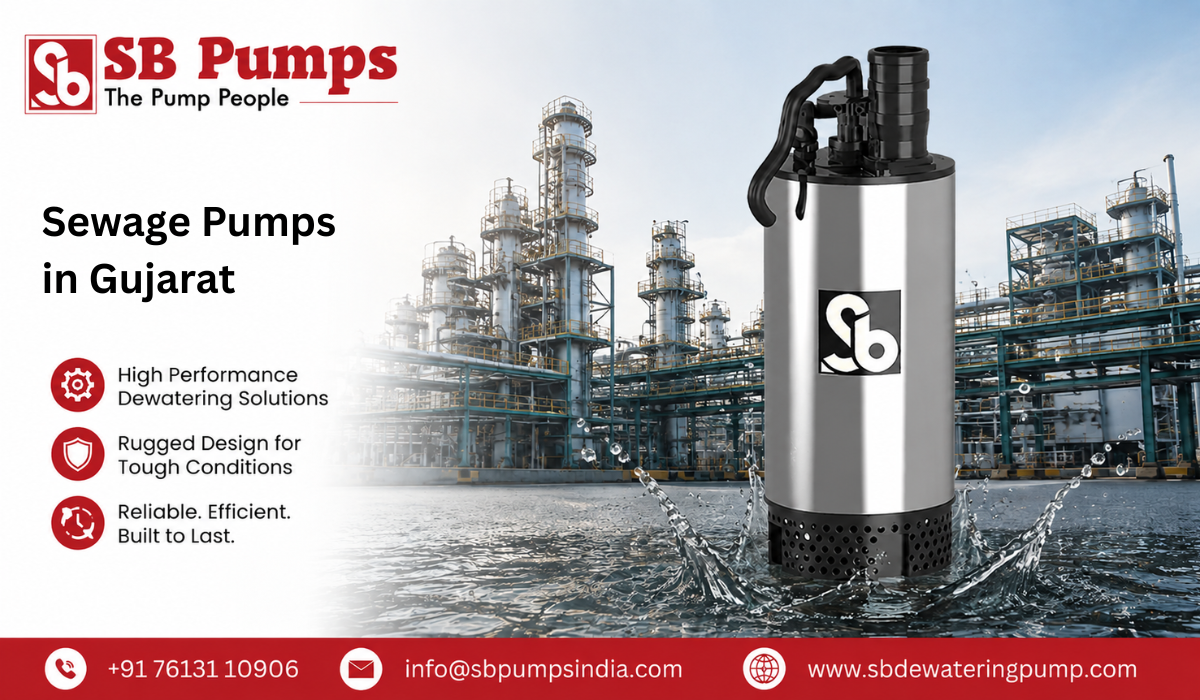
Choosing the right sewage pumping system is important for homes, commercial buildings, industries, municipalities, and wastewater treatment facilities where gravity drainage alone cannot move wastewater effectively. Buyers looking for Sewage Pumps in Gujarat need to consider more than pump capacity. The nature of wastewater, solids present in the fluid, discharge route, installation conditions, operating frequency, and maintenance requirements all influence the right selection. SB Pumps helps buyers evaluate these practical factors so that the pump matches the actual wastewater handling requirement rather than being selected only on price.
Sewage Pumps in Gujarat are designed to transport wastewater containing suspended solids and other contaminants from one location to another. They are commonly used where wastewater needs to be lifted from a collection pit, sump, underground tank, drainage point, or treatment area before being discharged into a sewer network or further treatment process.
Unlike pumps intended for clean water, sewage-handling equipment must be selected with attention to the possibility of solids, fibrous materials, sludge, and other debris. This makes impeller design, passage arrangement, pump construction, and installation conditions important considerations.
For buyers comparing Top Sewage Pumps in Gujarat, the objective should therefore be dependable wastewater movement, suitable solids-handling capability, and compatibility with the intended installation.
A sewage pump generally operates from a collection point where wastewater accumulates. Once the pumping system is activated, the rotating impeller creates the pressure required to move wastewater through the connected discharge pipe.
The pump must generate sufficient head to overcome the vertical lift and resistance created by the discharge pipeline, bends, valves, and other components. At the same time, the pump should be appropriate for the type of wastewater being handled.
Automatic operation can be incorporated through suitable level-control arrangements, allowing pumping to respond to changes in wastewater level. In larger installations, multiple pumps may also be considered depending on operational requirements and system design.
When evaluating the Best Sewage Pumps in Gujarat, buyers should focus on how the complete pumping arrangement will perform rather than judging the pump as an isolated component.
Different wastewater environments call for different pump configurations. Common considerations include:
The correct type depends on the wastewater characteristics, solids content, pumping distance, installation arrangement, and expected operating pattern. A Sewage Pumps Manufacturer in Gujarat should ideally assess these requirements before recommending a particular configuration.
Pump selection should begin with the actual operating conditions. Buyers should provide accurate information about the following:
Flow requirement: Determine how much wastewater needs to be transferred within the required operating period. Oversizing or undersizing can both create operational problems.
Total head: Calculate the vertical lift and pipeline losses rather than considering elevation alone. Pipe length, bends, valves, and discharge restrictions influence the required pumping head.
Solids and debris: Wastewater can contain fibrous materials, suspended solids, and other debris. The pump's passage and impeller arrangement should be appropriate for the expected material.
Fluid characteristics: Industrial wastewater may have different properties from domestic sewage. Temperature, chemical exposure, and abrasive content should be discussed before final selection.
Installation conditions: Available sump space, access for maintenance, pipe configuration, electrical arrangements, and pump positioning can affect the practical choice.
A reliable Sewage Pumps Supplier in Gujarat can use these details to help buyers avoid selecting equipment based only on catalogue capacity.
Sewage pumping systems are used across residential, commercial, industrial, and public infrastructure. Typical applications include apartment complexes, hotels, hospitals, educational institutions, factories, municipal wastewater systems, drainage installations, sewage collection stations, and wastewater treatment facilities.
Industrial locations may have wastewater containing materials that require additional attention during pump selection. For example, a food-processing facility and a residential building may both handle wastewater, but their solids characteristics and operating patterns can be very different.
For organizations comparing a Sewage Pumps Exporter in Gujarat, it is equally important to verify whether the selected configuration meets the destination project's operating conditions, installation requirements, and applicable procurement specifications.
Sewage pumping problems are often linked to selection, installation, or operating conditions rather than the pump alone. Blockages can occur when unsuitable solids enter the system or when the pump configuration is not appropriate for the wastewater. Reduced performance may result from incorrect head calculations, pipeline restrictions, or changing operating conditions.
Frequent starting and stopping can also indicate that the control arrangement or pump selection needs review. Leakage, unusual vibration, or abnormal noise should not be ignored because these may indicate installation, mechanical, or operating issues.
Instead of asking only for Sewage Pumps Price in Gujarat, buyers should request information about pump suitability, installation requirements, maintenance considerations, and the conditions included in the quotation.
Before you Buy Sewage Pumps in Gujarat, prepare a basic application sheet containing:
This information makes supplier discussions more productive and helps avoid unsuitable substitutions.
Buyers comparing Sewage Pumps for Sale in Gujarat should also examine after-sales support, spare-parts availability, service accessibility, documentation, and warranty terms alongside the initial purchase price.
SB Pumps approaches sewage pumping requirements from an application perspective. Instead of treating every wastewater installation as identical, the selection process can consider flow, head, solids, installation conditions, and expected operating patterns.
For Gujarat buyers, local project conditions can vary considerably between residential developments, industrial facilities, commercial premises, and municipal infrastructure. A practical evaluation can therefore help identify a pump arrangement suited to the actual duty.
The goal is not simply to supply a pump but to help customers make an informed equipment decision based on their wastewater handling requirements.
Start with flow, total head, wastewater characteristics, solids content, pipe arrangement, installation conditions, and operating frequency.
They can be suitable for many industrial wastewater applications, but the wastewater's solids, chemicals, temperature, and other characteristics should be evaluated before selection.
Total head represents the lifting requirement plus losses created by the discharge pipeline and fittings. It directly affects the pump's ability to move wastewater through the system.
No. Initial price should be considered alongside suitability, energy requirements, maintenance, service support, expected operating conditions, and spare-parts availability.
Yes, pumping systems can be arranged with suitable level-control mechanisms for automatic operation, depending on the installation design.
Provide the required flow, head, pipe details, wastewater characteristics, solids information, installation conditions, operating pattern, and electrical requirements.
Buyers can contact SB Pumps with their application details to discuss a suitable sewage pumping configuration and receive project-specific guidance.
Whether the requirement is for a residential development, commercial facility, industrial plant, or wastewater infrastructure project, proper application assessment can make pump selection more reliable. Contact SB Pumps with your flow, head, wastewater, and installation requirements to discuss suitable options and procurement considerations. For suitable Sewage Pumps in Gujarat, discuss your complete application requirements before final selection.